
Diving at Pete Tide II Ship (United States)
Exploring Pete Tide II provides a challenging wreck dive experience on Florida's Panhandle. An artificial reef, this intentionally sunk oil rig supply ship invites advanced divers to navigate its upright structure. Descending, you'll uncover three decks of superstructure, offering exploration opportunities. Its intact pilothouse holds particular interest, often drawing active schools of marine life within its open spaces. A dive here connects you with a significant piece of Gulf maritime history.
As evening covers Pete Tide II Ship, the local air temperature is measured at 30°C. The current wave height at the surface is recorded at 1 m. These late-day readings characterize the surface conditions for the night.
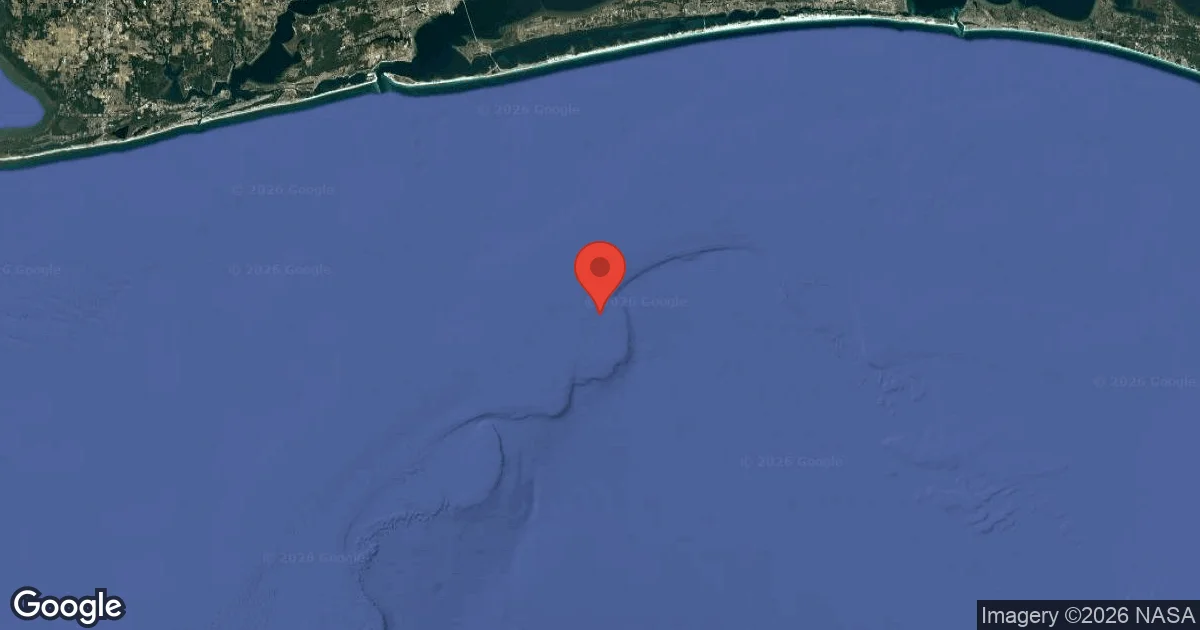
Dive Site Location & Key Facts
Dive Site Overview
Pete Tide II, a former oil rig supply vessel, rests upright on the seabed after its intentional sinking by Escambia County in 1993. Now a key artificial reef, it forms a prominent feature on the Panhandle Shipwreck Trail, inviting exploration.
Measuring 50.6 meters (166 ft) in length with an 11.6-meter (38 ft) beam, the substantial structure offers extensive opportunities for divers. Its base settles in approximately 30 meters (100 ft) of water, designating it a dive primarily for experienced individuals comfortable with deeper profiles and potentially extended bottom times. An intact superstructure rises to roughly 18 meters (60 ft) from the surface, presenting three distinct decks.
Divers can navigate various compartments and corridors across these levels with careful planning. A remarkably preserved pilothouse includes an accessible swim-through, a captivating feature for those with appropriate training and confidence in overhead environments.
Exploring past the upper decks leads to the ship's aft work platform before reaching the sandy bottom surrounding the hull. Overall integrity of the wreck provides comprehensive insight into its original design, offering numerous points of interest for underwater navigation and detailed observation.
Conditions are Excellent
07:00 - 14:00
Optimal conditions expected
Current conditions near Pete Tide II Ship show 30° air, 30° sea temperature, 0.5 m waves, and 21 km/h wind. Forecast data is refreshed regularly to ensure accuracy.
Best Time to Dive
Optimal visibility for diving Pete Tide II generally aligns with the warmer months when sea states are calmer. From May through September, conditions are rated "Good," characterized by average wave heights ranging from 0.7 to 0.9 meters and wind speeds typically between 23.1 to 26.5 km/h (14.3 to 16.5 mph). These periods often yield improved underwater clarity, enhancing the wreck diving experience. Air temperatures during these months are also pleasant, averaging from 24.5°C to 29°C (76-84°F). Conversely, the period from October to April is rated "Moderate," with higher average wave heights of 1.1 to 1.3 meters and stronger winds from 30.2 to 35.7 km/h (18.8 to 22.2 mph), which can reduce visibility and make surface conditions more challenging. While specific water temperatures are not consistently reported for this location, they generally follow regional seasonal patterns. Rainfall is relatively consistent year-round, not typically a primary factor for visibility here.
PEAK SEASON SCORE
Scores combine air & water temps, waves, wind & rainfall for overall conditions.
BEST MONTHS TO DIVE
Monthly records compiled from satellite and marine observation nodes over the last 3 years. Data provided by Open-Meteo and MET Norway.
Dive Experience & Conditions
Accessing Pete Tide II is exclusively by boat, typically requiring a dedicated charter due to its offshore location. Due to its depth, with the wreck lying at a maximum depth of 30 meters (100 ft) and the superstructure starting around 18 meters (60 ft), consider this an advanced dive. Divers should be proficient in deep diving and wreck penetration techniques if planning to explore internal sections beyond the pilothouse swim-through. While specific visibility reports can fluctuate, conditions generally offer decent clarity, though it varies with weather and currents. Currents around the wreck can be present, sometimes increasing in strength, so divers should be prepared to manage drift. Recommended training includes PADI Advanced Open Water Diver, PADI Wreck Diver, and PADI Enriched Air Diver to maximize bottom time and enhance safety on this deeper artificial reef.
Dive Difficulty & Safety Guidelines
While specific hazards are not consistently reported for Pete Tide II, wreck diving always presents inherent risks that require careful planning and execution. The considerable depth, with the wreck reaching its maximum recreational limit, necessitates advanced dive training and experience in deep diving. Divers exploring the interior of the wreck, such as the pilothouse swim-through, must possess proper wreck penetration certification and carry redundant lighting, lines, and cutting tools.
Strong currents can occasionally affect the site, potentially increasing the challenge of ascent and descent, so divers should be prepared for varying conditions. Always dive within your certification limits and ensure your equipment is well-maintained.
Proper gas management and a reliable dive computer are crucial for monitoring no-decompression limits and ascent rates, especially on deeper profiles.
Recommended Equipment
- Dive Computer
This gear list is based on verified equipment signals for Pete Tide II Ship, United States. Always confirm final gear choices with your dive operator, guide, or liveaboard.
Recommended Dive Suit
For divers planning standard recreational dives, dive skin or rash guard is usually a suitable option. A hood or vest is suggested for sensitive divers due to surface winds. Divers vary widely in how quickly they feel cold underwater.
The waters surrounding Pete Tide II Ship are currently maintaining temperatures close to 30°C (86°F). Surface air temperatures are resting at 30°C (86°F).
Environmental conditions may feel slightly cooler as the week progresses. Cooler days are ahead; you might want a warmer option for later in the week. Bringing an additional thermal layer can be helpful if conditions change.
Due to technical issues with our weather providers, live updates are temporarily delayed. The data above reflects the conditions at the time of the last successful fetch.
Emergency & Medical Support
Essential information to help you plan your dive trip to Pete Tide II Ship.

Hyperbaric chambers are a critical part of dive safety infrastructure. Availability varies significantly by region, and not all dive areas have immediate access.
Before diving, it's recommended to:
- confirm nearest medical facilities
- check emergency procedures with local dive operators
- ensure dive insurance covers evacuation if required
Divers Alert Network
Diving emergency assistance available through DAN World.
+1-919-684-9111- 24/7 emergency hotline
- Diving medical assistance
- Evacuation coordination
Emergency contacts are provided for reference. Always verify local emergency services before diving.
Marine Life at Pete Tide II Ship
Pete Tide II serves as an important habitat, attracting a diverse range of marine life to its structure. Divers frequently observe active schools of spadefish and minnows congregating around the intact pilothouse, utilizing it for shelter and foraging.
Adventurous divers exploring the ship’s aft work platform and the sandy bottom below should remain alert for larger pelagic species. Occasional sightings of wahoo and blackfin tuna are possible, patrolling the wreck's periphery. An artificial reef, its role makes it a focal point for the local ecosystem.

Dive Sites Near Pete Tide II Ship
View all dive sites in United StatesDiscover more underwater gems in this area.
Dive Centers Near Pete Tide II Ship
Today: 10:00 - 18:00
Nearest Airports
Nearest airports to help plan travel to this dive area.
Search Flights
Check available flights and routes on Expedia, using the nearby airports listed in this section.
Search Flights on ExpediaFrequently Asked Questions
What is the Pete Tide II Ship?
Pete Tide II is a former oil rig supply ship intentionally sunk in 1993 to create an artificial reef. It's a key site on the Florida Panhandle Shipwreck Trail, lying upright on the seabed.
What are the typical depths for diving the Pete Tide II?
Wreck structure begins in shallower sections, while its base extends to recreational deep dive limits. Divers can explore various decks and the pilothouse within these ranges.
What marine life can be seen at Pete Tide II?
Schools of spadefish and minnows are attracted to the wreck, particularly around the pilothouse. Divers also have the chance to spot larger species like wahoo and blackfin tuna near the ship's aft work platform and the sandy bottom.
What dive skill level is required for Pete Tide II?
Diving Pete Tide II is considered an advanced dive due to its deeper sections. PADI Advanced Open Water Diver certification is recommended, along with specialized training like PADI Wreck Diver for any internal exploration.
When is the best time to dive Pete Tide II?
Optimal diving occurs generally from May through September, when sea conditions are calmer and visibility tends to be better. Air temperatures are also warmer, contributing to a more comfortable overall experience.
Are there any swim-throughs on the wreck?
Yes, an intact pilothouse on Pete Tide II offers an accessible swim-through. Any internal exploration requires appropriate wreck diving training, sufficient light, and strict adherence to safety procedures.
Planning to dive Pete Tide II Ship?
Send one inquiry and receive offers directly from the best verified local dive operators.
Conditions are Excellent
07:00 - 14:00
Optimal conditions expected
Current conditions near Pete Tide II Ship show 30° air, 30° sea temperature, 0.5 m waves, and 21 km/h wind. Forecast data is refreshed regularly to ensure accuracy.